Are you thinking of applying for any online undergraduate or postgraduate degree in 2026? Wait! Before you start applying, it is important to check whether your Higher Education Institution (HEI) or program is approved by UGC-DEB. Does your shortlisted university follow its mandatory guidelines, curriculum, and infrastructure?
In India, UGC’s DEB vertical has been the primary education statutory body, which ensures your online degree is reliable, transparent, and provides equal career opportunities. Every university must get approval to provide an online degree program and follow various mandatory guidelines.
However, many students often fall into invalid programs or unethical admission practices, which cost them valuable years, commitments, and careers. So, it's crucial to check every guideline.
In this blog, we will guide you through some key UGC-DEB guidelines you must consider before taking admission in any online degree program.
What Is UGC-DEB Approval & Why Is It Important?
University Grants Commission Distance Education Bureau (UGC-DEB) is a statutory body of the Government of India. It is responsible for regulating the validity of online & ODL universities and programs. It ensures they follow a defined curriculum and are transparent.
UGC-DEB approval is mandatory for online programs to make sure they are valid for higher education and job opportunities. It also makes the online courses equivalent to an on-campus degree.
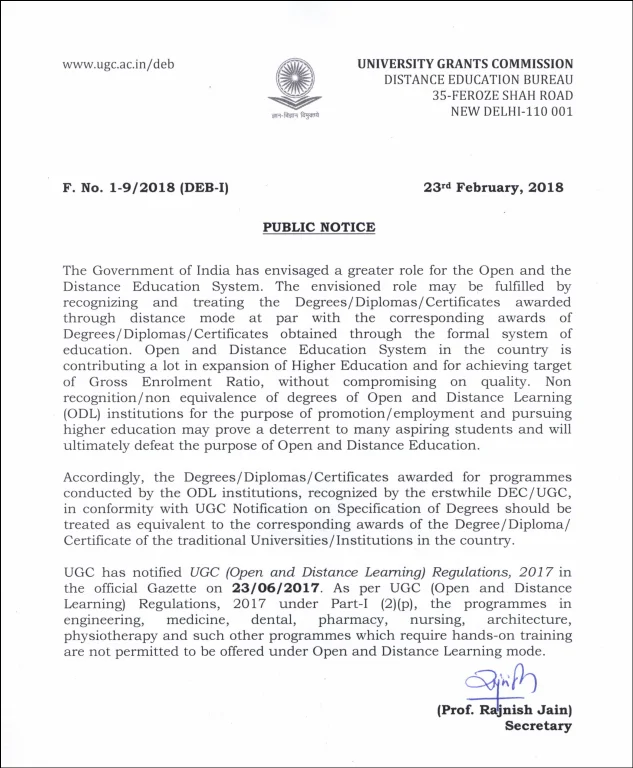
Source: UGC-DEB
Every Higher Education Institution must be approved by this statutory body for offering any PG, UG, diploma, or other online programs.
What are the Key UGC-DEB Guidelines for Online Programs?
The UGC-DEB issues many guidelines on a regular basis to ensure your degree is valid, HEIs run in a structured manner, and you get a transparent chance to showcase your skills in the real world.
Some of the key guidelines you must consider before taking admission:
1. Validity & Recognition of Online University & Programs
It is foremost important to make sure your shortlisted university has a valid UGC-DEB approval. The statutory body releases a list of online universities every year, on which higher education institutions are approved and restricted from providing any distance or online programs.
The UGC-DEB has approved over 126 eligible and recognized universities and various programs such as MBA, MCA, and BCom. Additionally, it has prohibited key programs, such as Engineering, Medical, and Nursing.
Make sure to verify the approvals before finalizing your admission. If you take admission in any restricted or fake university, your degree is considered invalid, and you will not be eligible for further education and career opportunities.
The official list of approved universities and programs is:
| List Types | Official List (2025-26) |
| Approved HEIs (University) & Programs | Recognized HEIs: Official List 2026 Entitled HEIs: Official List 2026 |
| Fake HEIs | Fake University List 2026 |
| Restricted Programs | Prohibited Programs 2020 |
2. University Compliance
Every university must be approved by UGC-DEB to provide online programs for the respective academic session. Additionally, you should also check for additional recognitions, such as AICTE, NIRF ranking, NAAC rating, and WES.
- The Institution must be legally notified and affiliated with the state or central government & bar council.
- It must release a transparent academic calendar that includes the admission process, batch size, program offered, examination schedule, and admission window.
3. Quality Assurance
UGC-DEB has always prioritized quality education to ensure you are well-skilled to grow in the real world. The regulatory body has imposed rigorous norms that every HEI must follow for its online programs. Some of the key assurances are:
- CIQA Report: Institutes should provide annual reports based on their education quality, SLM, and support. The internal board must impose a monitoring committee to prepare a Program Project Report (PPR) and submit it to the vice-chancellor of the HEIs.
- Faculty: They must have a full-time dedicated faculty or staff, and must avoid employing part-time or borrowed from any other institutions.
- Learning Materials: They must have a dedicated Learning Management System (LMS) with regular conduct of classes, digital library infrastructure, and access to recorded lectures.
- Student Support & Grievance Redressal: The institution must provide 24/7 support to its online students in academics, doubt clearance, and to avoid any kind of discrimination.
4. Admission Process & Dates
The UGC-DEB has rigorous guidelines for the admission process and window:
- The admission process must be 100% online from registration, documentation, to confirmation.
- To start a new course, the HEI must seek prior approval from the UGC-DEB
- The eligibility criteria should be the same for every student, with an average concession of 5% to the reserved category
- If there is any entrance, the university must be transparent in evaluations and the release of the merit list.
- It must follow the pre-assigned process in Biannual-Admission cycles, January and July, respectively, with a fixed window.
| Admission Cycle | Registration Start | Window Closes | Batch |
| Jan/Feb | October | January | Feb |
| July/August | March | June | July |
- However, in case of seat vacancy, the respective HEIs are allowed to further extend their admission window by 7-15 days.
5. Fee Structure & Scholarship
HEIs must submit and take prior approval on the fee structure, scholarship, waiver, and process before starting their academic sessions. Additionally, the institution must have a transparent structure of every fee, like tuition, development, infrastructure, registration, and exam fees.
The university must allocate some seats for minority or other reserved category students, and follow these rules
- 50% shall be filled based on a merit list prepared by the competent authority.
- The remaining 50% should be equally classified as free seats and payment seats, respectively.
6. Foreign Candidates: Admission & Documentation
The Indian Online University should also allow equal admission opportunities to both national and international students. The admission process must be the same, with extra required documentation, such as a visa, a passport, and/or a valid document.
The admission process must be clear and transparent. HEIs must only consider AIU-recognized universities to take admission into any of their courses for a seamless documentation process.
7. Credit Transfer (ABC-ID & DEB-ID)
The UGC-DEB has made it mandatory for every student to create their ABC-ID and DEB-ID during the admission process. You can create your ABC-ID through its official website or Digilocker, followed by DEB-ID creation.
National Credit Framework (NCrF): Check Guidelines
The National Credit Framework (NCrF) understands that the NEP-2020 guidelines make it mandatory to create ABC & DEB IDs to provide seamless access, storage, and transfer of credits between multiple institutions.
8. Multiple Entry Exit Point
UGC has announced the Multiple Entry and Multi-Exit (ME-ME) scheme to ensure a lifelong learning provision for OL, ODL, and on-campus students. It also allows you to exit at any point, resume it from the same point, or complete your degree with a relevant certification.
Multiple Entry and Multi-Exit Initiative: Check Guidelines
The validation of your degree with the ME-ME initiative, for example, for an undergraduate is:
| Exit Points | Degree Recognized As |
| 1st Year | Certification |
| 2nd Year | UG Diploma |
| 3rd Year | Full UG Degree |
| 4th Year | UG Honours/Research |
The UGC-DEB also allows you to shift from offline to online and vice versa without losing your precious time or academic credits.
9. Dual Degree
You can now pursue multiple degree programs at the same time to save your time and gain additional skills beyond just single-core skills. The official UGC’s guidelines for the dual degree program are:
- You can pursue two, one online or a combo of OL with ODL or a full-time course simultaneously; however, their classes or exams should not overlap.
- For diploma and degree programs, they must pursue them from HEIs that are UGC, AICTE, or the Government of India.
10. NEP-2020 Guidelines
The Ministry of Education has announced the innovative National Education Policy (NEP) 2020 to level up GER in higher education. Online degrees have played an important role in boosting the Gross Enrollment Ratio by approximately 25%.
NEP 2020 Guidelines: Silent Features
The key guidelines of the NEP 2020 initiatives are:
- Focus on startup support, practical implementation, research, and technology rather than just theoretical knowledge to make students stand out in the current market demands.
- Its curriculum must emphasize the Choice-Based Credit System (CBCS), the Indian Knowledge System (KIS), and interdisciplinary skills, with flexibility to choose vocational and elective subjects at their convenience.
- HEIs must implement core soft skills, vocational subjects, critical thinking, creativity, AI, modern concepts, communications, and other disciplinary & interdisciplinary skills for the holistic growth of students.
- Exam Security should be conducted regularly, under surveillance, to avoid cheating, and HEIs must include unbiased & fair evaluations based on merit.
11. International Academic Collaborations
For collaboration with any foreign universities, companies, or training institutions, HEIs must tag the course as a twinning, joint, or dual-degree program.
The key guidelines are:
- The collaborator must be approved by their respective education board, the Government, the Boards of Management, and the UGC.
- They should mutually agree to comply with the laws and regulations of their respective countries.
- Both Indian HEIs and Foreign Institutions must sign MOUs that include the provision and purpose of the collaboration.
- The Online HEIs should issue a transparent curriculum on what foreign collaborators are actually providing, whether practical, internship, or professional certifications.
- The credit of the Foreign HEIs should not exceed 30% of the total credits.
- HEIs must have adequate academic infrastructure, such as a library, workshop, and virtual labs, which should match the requirements of the foreign collaborator.
12. Employer Acceptance
The online courses are UGC-DEB-approved and carry equivalent value as a traditional degree program.
- Every employer, whether private, MNCs, startups, governments, or PSUs, must not base their selection criteria on the mode of education.
- In case of compliance violation, the employer might encounter legal and monetary consequences or might even get blacklisted.
Can UGC-DEB Approved Online Degree Holders Apply for Government Jobs?
The online degrees are approved by UGC-DEB and carry equal recognition as on-campus degree programs. These degrees make you eligible for all government jobs, whether you are preparing for UPSC, RBI, Bank, SSC, Railways, or any central or state-aligned profile.
Additionally, the online course comes with flexibility to learn at your own pace and focus on acquiring knowledge that helps you gain an edge in these competitive exams.
What are Common Myths About UGC-DEB-Approved Online Degrees?
Online degree programs are gaining popularity among students for their practical approach and unmatched flexibility. However, some common myths about their validity, credibility, and employer acceptance are widespread among many individuals.
Some of the common myths are:
- Online degrees are not valid: This is the biggest misconception; the UGC-DEB has approved every online degree program, which makes them valid for higher education and job opportunities, just like on-campus and distance degrees.
- Government jobs don't accept online degrees: As online courses are accredited by UGC-DEB, your degree is fully acceptable for all government jobs; the only thing is that their eligibility criteria should match your degree level.
- Online degrees are different from regular degrees: Both online & regular programs follow the same curriculum, and are approved by UGC, making them on par with each other.
How to Check if a University is UGC-DEB Approved or Not?
You must verify whether the shortlisted university is approved by UGC-DEB or not. If it is not verified, you might suffer consequences, such as your degrees being discarded by the employer and loss of your valuable money and commitments.
You can use these steps to verify whether your institution is approved:
- Visit the official website of UGC-DEB at deb.ugc.ac.in
- Download the officially approved HEIs list
- Search “University Name” in the PDF
- Verify its course and approval
What Is The Difference Between An Online & Regular Degree?
Both online and regular degrees are approved by UGC-DEB and equally valid for job opportunities and higher education. However, the main difference lies in their delivery and flexibility. Some of the significant differences are as follows:
| Factors | Online Degree | Regular Degree |
| Delivery | Fully Online via LMS | Physical Delivery |
| Class Type |
|
|
| Cost Effective | 30-40% cost-effective | On the Higher Side |
| Entrance & Admission | Direct Entry | Require Entrance Exams |
| Attendance | NA | Min. 75% |
| ROI (MBA) | 4-5X | 2X |
Online vs ODL: Which is best for Your Career?
Online and distance education have some key differences based on delivery, technology, and employer acceptance as follows:
| Key Factors | Distance Degree Program | Online Degree Program |
| Course Delivery | Blend of Physical & Online Classes | 100% Online |
| Affordability (MBA) | ₹1 - 3 Lakhs |
|
| LMS |
|
|
| Technology Used |
|
|
| Exams Mode | Offline | Pen and Paper Mode | Fully Online & Proctored |
| Employer Acceptance | Might not be preferred by some employers | Highly Preferred for Corporate Readiness |
Conclusion
The UGC-DEB regularly releases some rigorous guidelines for all online and distance HEIs to ensure their credibility and fair conduct. You must verify whether the university you are enrolling in is approved for provision.
The core guidelines for the online program, such as ME-ME, credit transfer, and employer, are beneficial for students like you and also help boost the national GER.