![Is an Online Degree Valid for Government Jobs in India? [Complete Guide 2026]](https://d34odytkc8nsi8.cloudfront.net/blogs/thumbnails/1781182031423-0.webp)
Thinking about getting a completely online degree to become eligible for government jobs in India, and finding it rather difficult to evaluate the credibility factor. This is a very common inquiry among many government sector aspirants, and can only be answered with clear and to-the-point facts.
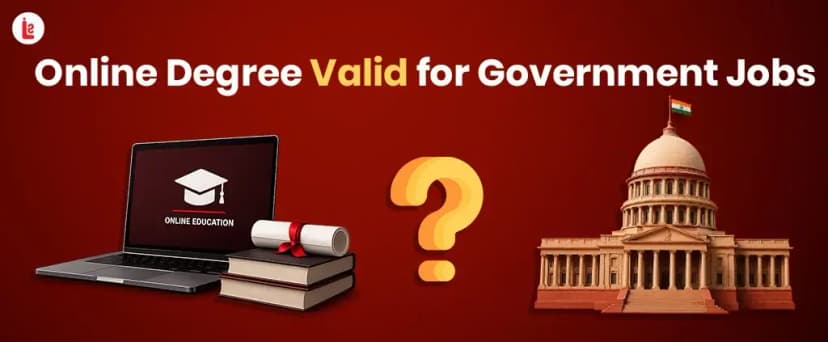
Since online degrees are approved as per UGC-DEB guidelines (2018), they will be valid for a government job. However, doubts arise for a government aspirant when the question comes up about verifying the credibility of both the online course and its university.
In this blog, we will guide you through each critical perspective and its legal facts related to the topic.
What Government Exams Accept an Online Degree?
Both Central and State Government jobs will be accessible to you if you complete an online degree from a UGC-DEB-approved university. Thus, you can appear for government exams such as UPSC, SSC, or RRB after completing an online degree.
However, to get posted as a government officer, you will have to pass the entrance exam specific to your aspired profile. For example, if you aspire to become an IAS officer, you will have to pass the UPSC exam. An online UG degree will only make you eligible for the UPSC exam.
Which Online Degrees Are Valid for Government Jobs?
All levels of online degrees are valid for government jobs in India. This list includes online BA, BCom, BBA, MBA, MCA, etc. Thus, if you have completed your master’s degree in an online mode in any stream and did not get what you expected in the private corporate world, you can still prepare for a government sector job.
Many top UGC-DEB-recognised universities in India, such as Amity University, UPES, and NMIMS, provide full-fledged online UG and PG degrees that are considered equal to the regular degrees as per the UGC guidelines.
Thus, getting an online degree is not the real matter; getting it from an approved university is what really matters!
Is an Online Degree equal to a regular degree in India?
Yes, your online degree is 100% legal and credible in India. As per the University Grants Commission 2018 notification for “Online Courses or Programmes, educational institutes/universities can offer full-fledged online degrees, diplomas, and certificates in India.” These institutes/universities must already be offering the same regular/ODL programmes, with the condition of at least one batch passed out.
Approvals Required for an Online Degree
The following are the government bodies/authorities that provide key approvals for your digital degrees and programs in India.
- UGC: University Grants Commission is the supreme body for recognising online degrees and their universities. No virtual degree is legally valid or accepted for government jobs without precise entitlement from the University Grants Commission.
- DEB: The Distance Education Bureau's role is to handle non-traditional education in India. All the universities require mandatory approval from DEB. While a university may have general UGC recognition, the DEB issues mandatory, program-specific approvals annually. The exact online course must be listed on the DEB portal to be valid.
- AICTE: All India Council for Technical Education is responsible, as the name itself suggests, for technical education in India. This covers programs such as MBA and MCA. However, Online Universities with UGC approval do not necessarily require AICTE approval.
Its formal approval is only mandatory for those autonomous institutes, such as IIMs, that do not fall under this premier statutory body umbrella, as they function under their own Parliament IIM Act.
- NIRF: The National Institutional Ranking Framework is the official ranking by the Ministry of Education for Indian universities and colleges. It is required for the parent organisation of the online universities to be ranked amongst the top 100 in two of the previous three annual NIRF ranking lists.
- NAAC: National Assessment and Accreditation Council is an autonomous quality assurance body that rates universities in grades. These institutions also fall under UGC and follow all the requisite guidelines to assess the courses and the universities. NAAC only permits universities to offer fully digital degrees if they maintain a CGPA score of 3.01 or above.
How to Verify the Validity of an Online Degree?
Go through the steps below to check the legal authenticity of your fully virtual courses:
- Verify via the UGC-DEB Portal: Visit the official Distance Education Bureau website at deb.ugc.ac.in. to confirm the legal aspect, whether the university is authorised or not.
- Check the Specific Academic Year: Check the current active status of the university’s recognition and see if the validity extends to your exact year of admission and enrollment.
- Confirm Program-Specific Approval: Verify that your exact digital course, such as BBA, MBA, is mentioned (listed) among the approved program list, as only university approval is not enough.
- Look for AICTE Approval (For Technical/Management Courses): For professional online technical programs like an MBA or MCA, confirm that the university is UGC-DEB-recognized, and if it's not, it must hold a valid AICTE approval.
- Check the NAAC Grade: The university must hold a National Assessment and Accreditation Council (NAAC) accreditation with a minimum CGPA score of 3.01 or above.
- Verify NIRF Rankings: Confirm the institution ranks within the Top 100 in the National Institutional Ranking Framework (NIRF) university category for at least two of the past three annual cycles.
Top-Ranked UGC-DEB-Approved Online Universities
You can pursue 100% legal and UGC-DEB-approved digital degrees from the following universities, whether private or government. Let’s see their NIRF ranking in 2025 and the valid approvals/authorisations as provided.
Premier Private Universities in India as per 2025 NIRF University Category Rankings
| NIRF Rank | Private Online University | Approvals |
| 3 | MAHE University |
|
| 20 | Chandigarh University |
|
| 22 | Amity University |
|
| 24 | Symbiosis University |
|
| 31 | Lovely Professional University |
|
| 41 | D. Y. Patil University |
|
| 45 | UPES University |
|
| 52 | NMIMS University |
|
| 62 | Jain University |
|
| 63 | Christ University |
|
Reputed Government Universities as per 2025 NIRF University Category Rankings
| NIRF Rank | Government Online University | Approvals |
| 1* | IGNOU University |
|
| 20 | Anna University |
|
| 23 | Andhra University |
|
| 43 | Mahatma Gandhi University |
|
| 44 | Alagappa University |
|
| 71 | University of Mysore |
|
| 82 | Mizoram University |
|
| 85 | Madurai Kamaraj University |
|
| 87 | Guru Nanak Dev University |
|
| 35* | Kurukshetra University |
|
*IGNOU is ranked 1st amongst the Open NIRF University Category (2025)
*Kurukhsetra University is ranked 35th among state-public universities category (NIRF), while it is 127th in the university category.
To get the full list of the UGC-DEB-approved universities and their courses, you can refer to this PDF.
What are the Salary & Benefits of Government Jobs After an Online Degree?
These digital degrees offer the same government job opportunities for a stable and secure future. You do not need to spend a high fee amount if you are looking to secure a government job. You can skip the competitive entrance examinations and simply get a direct admission to your favourite virtual university. This saves your time and money, allowing you to focus more on your government job examination.
Top Government Jobs to Pursue After an Online Degree
After completing your digital degree, you have to pass the mandatory government examinations to get selected. Let’s have a look at these profiles, the required entrance examinations and their basic salary range.
| Job Profile | Entrance Examination | Salary Per Month (Basic) |
| ISRO Scientific / Technical Assistant | ISRO ICRB Standalone Exam (ISRO Centralised Recruitment Board & Technical Interview) | Rs ₹44,900 |
IAS, IPS, and IFS (Civil Services Officer) | UPSC CSE / State PSC Exams (Civil Services Examination / State Public Service Commissions) | Rs 56,100 |
PSU Jobs (NTPC, ONGC, IOCL, PGCIL) | GATE (Graduate Aptitude Test in Engineering) | Rs 50,000 - 60,000 |
| Commissioned Defence Officer | UPSC CDS / AFCAT (Combined Defence Services / Air Force Common Admission Test) | Rs 56,100 |
| Income Tax Inspector, Central Excise Inspector, Assistant Section Officer | SSC CGL (Staff Selection Commission Combined Graduate Level) | Rs 44,900 |
| DRDO Senior Technical Assistant-B (STA-B) | DRDO CEPTAM Exam (Centre for Personnel Talent Management Entrance Test) | Rs 35,400 |
| Junior Statistical Officer (JSO) | SSC CGL (Staff Selection Commission Combined Graduate Level) | Rs 35,400 |
| Probationary Officer (PO) (SBI, IBPS, and Nationalised Banks) | SBI PO / IBPS PO (Common Written Examinations & Interviews) | Rs 48,480 – 56,480 |
| RBI B-Grade Officer | RBI Grade B (DR) Exam | Rs 78,450 |
Station Master Goods Guard Traffic Assistant (Indian Railways Jobs) | RRB NTPC (Non-Technical Popular Categories) | Rs 25,500 - 35, 400 |
| Trained Graduate Teacher (TGT) (Class 6-10) | B.Ed + CTET (Paper II) / State TET + recruitment exams (KVS, NVS, DSSSB, or State-level school boards) | Rs 44,900 |
| Post Graduate Teacher (PGT) (Class 11-12) | B.Ed + Direct State Board Recruitment Exams / KVS / NVS / DSSSB PGT Exam | Rs 47,600 |
Source: Ministry of Finance
Note: Government employees' salaries in India are a combination of basic pay scale and further allowances depending on the city tier. The overall gross salary includes the following types of allowances: DA, GA, SA, and HRA.
Why Students Choosing Online Degrees Over Regular Ones?
The latest report from the Corporate Recruiters Survey 2025, GMAC says that more than 55% of employers honour online degrees equally to regular degrees. This clearly demonstrated the value of your fully virtual degree and how, in the future, given AI development, corporate acceptance of these in domains such as tech, data analytics, and business management is likely to improve significantly.
For both students and working professionals, digital degrees have made higher education possible from the comfort of their personal spaces. Further, this eliminates the need to go through competitive entrance examinations or leave their jobs, and significantly reduces the overall study cost.
The best part is that you can start your government job preparation right after the 12th and get a graduation degree without even going to the university once. This feature of online degrees has really boosted confidence in government job aspirants by not only making them focus on their studies but also by backing them up with a Plan B.
Conclusion
Your online degree in 2026 is completely valid and makes you eligible to appear for government examinations for leading and respected job opportunities. To become 100% sure of its legal validity in India, you need to visit the official UGC-DEB website and check the list of approved digital universities and their courses.
If both the online universities and their courses are mentioned in the list, then your virtual degree is valid. Other legally credible authorisations, such as AICTE approval for technical programs, a high NAAC accreditation grade for quality assurance, and a strong NIRF ranking, are very important to improve the overall credibility and corporate acceptance of your virtual degree.