For years, one exam has stood as a toll gate to India’s management dream. Clear it, and the road looks wide enough. Miss it, and suddenly the future feels negotiated. And that exam is k/a CAT. It has produced some of the finest managers in the country. It has also quietly sidelined millions of capable, intelligent, and ambitious people who simply don’t fit the mould of a three-hour, high-pressure, percentile-driven test.
Here’s the uncomfortable truth we don’t want to accept, & that is ‘CAT is not a measure of potential. It is a filter, and a very specific one.’ It rewards speed over depth, test temperament over real-world execution, and often access to coaching, time, and multiple attempts over lived experience. For many, the issue is not ability, but alignment with the format.
Which is why this blog exists. Not to discard the value of CAT. But, how not to get undermined by elite institutions? And to ask a very honest and direct question - Should one exam decide who gets to become a manager in a country as diverse, ambitious, and fast-moving as India? Because we are living in a time where careers are no longer linear and professional growth rarely follows a single, predefined route.
Is an MBA Without CAT Possible?
We live in an era where working professionals are upskilling mid-air, fresh graduates are pivoting their careers faster than syllabus updates, and entire job roles are being redefined by technology and AI. Still, many talented people believe that “if they didn’t crack the CAT, they can’t pursue an MBA.” This belief is outdated, but more importantly, it is costly.
Believe me when I say this, but there are credible, career and industry-aligned ways out there to pursue an MBA without even appearing for CAT. Talking about its quality, they prioritise learning, application of theory, and return on investment over rank lists and cut-offs.
That is why this blog is for students who gave CAT their honest shot, working professionals who can’t afford to put their life on pause for exam prep, and career switchers who actually value skills over show-off symbols. If you’ve landed a college of your choice via CAT, that’s great. But if you haven’t, remember you’re not settling for less, you’re choosing just differently, and sometimes, that is a more strategic move.
CAT Success Rate, the Numbers Nobody Prepares You For
Every year, CAT attracts a large no. of aspirants, all competing for a very small number of seats. On average, 2.5 to 3 lakh candidates register for the CAT exam every year, driven by the purpose of an IIM tag and the career acceleration it brings. Against this 2.5-3 lakhs registration, the total number of seats available across all IIMs comes around 6,000 to 7,000, which creates a gap that is impossible to fill.
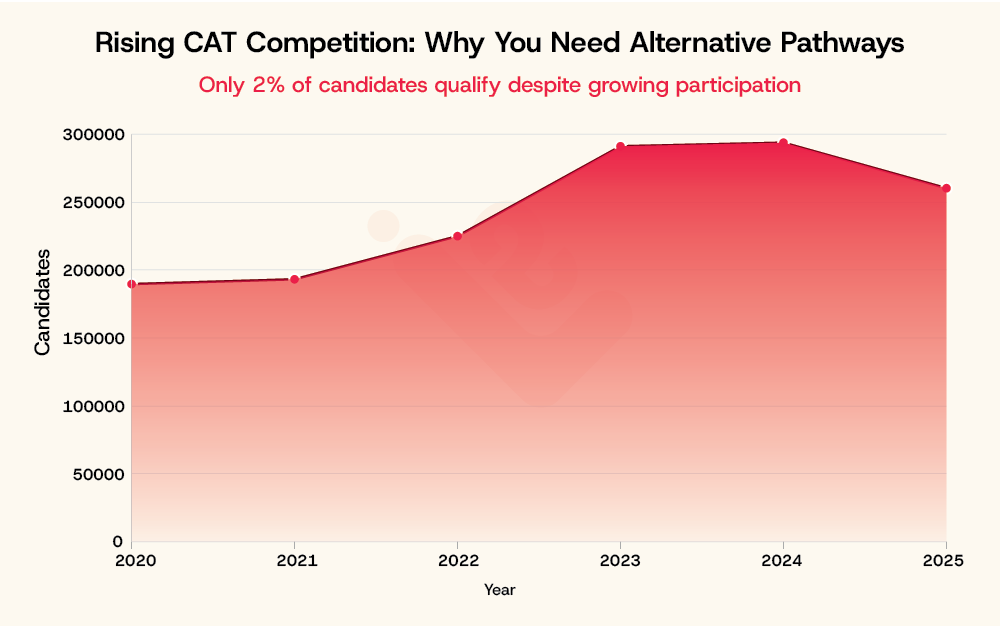
You know, when you convert these numbers into real outcomes, the picture becomes crystal clear. The overall average success rate for securing a seat in IIM through CAT is around 1.5–2%. In other words, out of every 100 serious aspirants, about 98 will not make it & fail. Not because they are incapable, but because the opportunity is extremely narrow. Even a strong performance can never guarantee your success in exams like CAT.
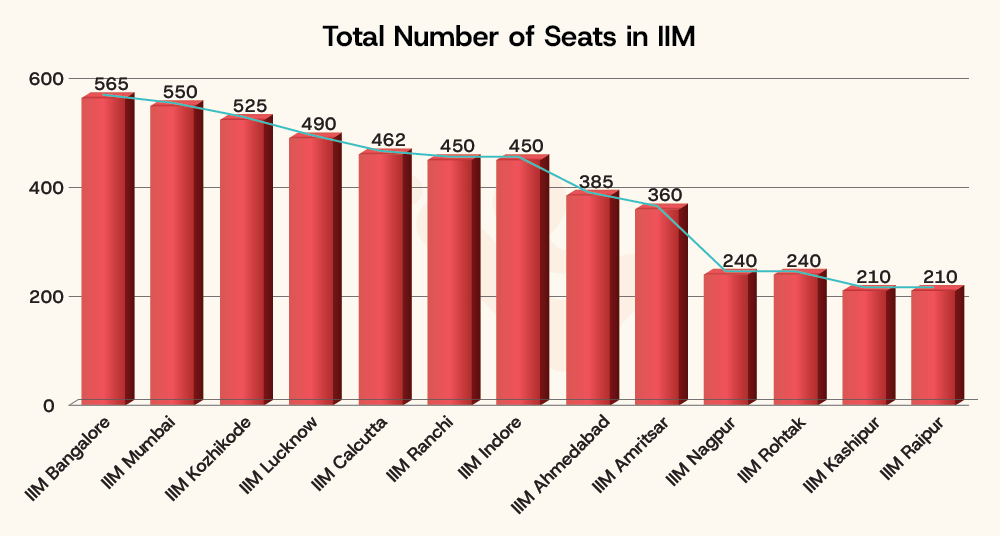
A common misconception is that scoring a high percentile in CAT will solve everything. In reality, candidates with 95+ percentiles still fail to secure a college due to sectional cut-offs, a mismatch in academic profile, work experience criteria, or interview performance. CAT is only the first filter in a multi-stage elimination process; it does not give you the final verdict.
What these numbers clearly indicate is not a lack of talent, but a limitation of availability. CAT was never designed to accommodate the scale and diversity of India’s management aspirants. Understanding this data is important because it reframes the conversation. A conversation that argues that not cracking the CAT is not a personal failure, but rather a statistical reality. And once you can see that clearly, exploring other pathways to MBA beyond CAT will stop feeling like a fallback and start sounding like a rational & informed decision.
Why CAT Isn’t for Everyone and Why That’s Okay!
You can observe easily that CAT is marketed as a universal benchmark, but in reality, it favours a very specific type of candidates only. The exam awards those who have time to prepare full-time, can practise under in vitro conditions again & again, and who can master every section with speed. For students who are comfortable in exam-centric environments, this works well. For others, it does not.
Working professionals, for instance, face an automatic disadvantage. Why? Because balancing long office hours & family responsibilities leaves no room for the intense practice that CAT demands. Another important factor is that candidates from non-mathematical or non-engineering backgrounds struggle a lot with the quantitative nature of the exam, despite having strong analytical & managerial skills…if you can’t calculate like a calculator, supposedly you’re not worth it.
CAT also seems to discriminate against late bloomers and first-generation aspirants. Because those without access to expensive coaching centres, networking, or multiple attempts, these people find themselves competing on an uneven playground. As time passes, the exam is becoming less about aptitude and more about having an advantage over time.
Having an understanding of these limitations is not an attack on CAT or the institutions that use it. It is simply an honest opinion that no single exam that is conducted annually can fairly capture the potential of a country as large and as diverse as India. Not clearing the CAT does not mean you are not a good fit for management; it means your strengths lie beyond what the exam is trying to test.
The Cost of Chasing CAT. The Hidden Price Nobody Talks About
When people talk about the CAT exam, they usually discuss how difficult the exam is, cut-offs, and percentiles. But what they completely ignore talking about is its cost, not just financial, but personal and professional costs too. On average, a serious CAT preparation involves ₹50,000 to ₹1.5 lakh in coaching fees, mock tests, and study material. For many aspirants, especially from middle-class backgrounds, this is a huge investment with no guaranteed return.
Then comes the opportunity cost, which is far more expensive and completely invisible. A typical CAT aspirant may spend 1–2 years in preparation, during which career progression stops completely. Aspirants have to turn down opportunities, promotions, or job switches, in the hope that the next attempt will be the one. And for fresh graduates, this delays their entry into the market altogether.
There is also a psychological cost that data increasingly supports. Surveys conducted by educational platforms show high levels of stress, burnout, and anxiety among competitive exam aspirants in India. A year-long preparation cycle, repeated attempts, and social comparison take a heavy toll on the confidence and decision-making of a candidate. By the time results arrive, candidates are emotionally exhausted, even if they perform really well.
So, when you combine all these factors, ie, financial spend, lost time, and mental strain, the real cost of chasing CAT becomes way too high for a person in their 20s. I understand that for a small percentage of candidates, the payoff is worth it. But for the majority, the return on this investment remains uncertain. This is not an argument against attempting CAT, but a reminder that the decision should be strategic. When the cost of trying starts to outweigh the value of alternatives, you must reconsider whether the pursuit still aligns with your long-term career goals.
What Happens to the 98% Who Don’t Crack the CAT?
Every year, once the CAT results are declared, a similar pattern is followed. A small percentage of aspirants move ahead with interview calls and final admission procedure, while the majority of aspirants are left at a crossroads. Many students react immediately in confusion rather than clarity. Months & years of preparation ended like it was nothing, with no clear next step in mind.
Also, a significant percentage of candidates choose to repeat the cycle. They attempt CAT again, hoping that another year of preparation will change the outcome. While this definitely works for a few aspirants, many find themselves stuck in a loop. It delays their career growth while chasing very marginal improvements in percentile. And with time, this gap between academic life and professional progress increases so much that there’s no going back.
Some pivot in a hurry and get themselves enrolled in a low-quality MBA program just to avoid “wasting a year.” These decisions, as you can see, are mostly driven by fear, not because it suits them, which leads to a degree that adds little to no value in the job market. While in most cases, aspirants abandon the idea of the MBA completely, & they settle for roles that offer them limited long-term growth.
But still, there’s something that ties all these outcomes together, which is not the lack of ability, but the lack of alternatives. If you think CAT is the only gateway to your success, failure feels final. In reality, it is only another way, not the only one. Knowing about what happens to the other 98% candidates is important because it gives you the freedom to explore other structured, credible MBA pathways.
MBA Without CAT: Let’s discuss Myths vs Reality
It’s been a very long time, and the phrase “MBA without CAT” has carried a very unfair stigma. It is always assumed to be a type of compromise where a learner settles for lower academic quality, lower credibility, and lower career outcomes. These kind of assumptions exists because CAT-centric narratives dominate the conversation that happens around (MBA) management education, which leaves little room for nuance or updated realities.
One common myth is that employers do not respect MBAs earned without CAT. In practice, hiring trends tell a different story. Recruiters increasingly prioritise skills, work experience, problem-solving ability, and communication over entrance exam scores. Once a candidate enters the interview room, the CAT percentile rarely features in the discussion. What matters is how effectively they can apply management concepts to real business problems.
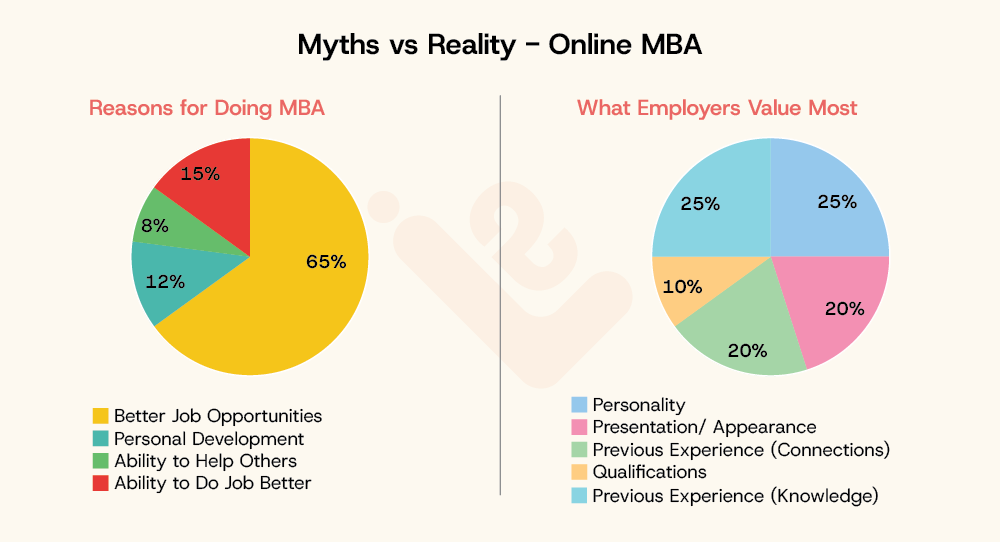
Another widespread misconception is that CAT-free MBAs lack academic quality or recognition. But in reality today, many of these programs without CAT, especially online MBAs, are offered by UGC-recognised universities with the latest curriculum, continuous online assessment using different methods, and market-ready content. The mode of admission can not automatically decide the quality of education or its learning outcomes.
The reality is that the management education landscape has now evolved, but public perception is still singing the 2010s song. I agree, CAT remains a prestigious route to the master’s degrees in management, but it is no longer the only way to success. An MBA without CAT does not mean you’re taking shortcuts; it’s about choosing a path that aligns better with you personally, economically, & mentally.
Path #1 – Regular MBA from Private Universities (Without CAT)
One of the most common paths for students who choose not to pursue CAT is a regular, full-time MBA from a private university. Many private universities offer direct admission to these PG courses based on graduation marks, internal aptitude tests, or personal interviews, without requiring CAT scores. For aspirants who want a traditional campus experience and a living environment for studies, this route is pretty straightforward.
These programs often provide a wide range of specialisations, access to faculty-led classroom learning, and peer interaction via classroom discussions and group projects. In some cases, private universities also invest heavily in infrastructure, branding, and industry tie-ups, which adds up to provide an overall learning experience.
However, this option doesn’t look easy when cost enters the picture. A regular MBA from a private university typically ranges from ₹6 lakh to ₹25 lakh or more (excluding living expenses). For many students, this translates into significant education loans and long repayment cycles. The financial risk is compounded by the fact that placement outcomes vary widely across institutions.
Beyond fees, rigidity is another limitation. Full-time campus programs require students to step away from work for one to two years, making this option less practical for working professionals. While private university MBAs without CAT can work for some, they demand a high financial and time commitment, which may not always align with the return on investment. This gap is what has led many aspirants to consider more flexible and cost-effective pathways.
Here is a list of the top 10 private MBA colleges in India as per the NIRF 2025 Rankings.
| NIRF-Management Rankings 2025 | Private Management Colleges | City |
| 9 | MDI Gurgaon | Gurugram |
| 10 | XLRI Jamshedpur | Jamshedpur |
| 11 | Symbiosis Institute of Business Management | Pune |
| 20 | S. P. Jain Institute of Management & Research | Mumbai |
| 24 | SVKM`s Narsee Monjee Institute of Management Studies | Mumbai |
| 26 | Amrita Vishwa Vidyapeetham | Coimbatore |
| 30 | IMT Ghaziabad | Ghaziabad |
| 32 | Chandigarh University | Chandigarh |
| 33 | MICA | Ahmedabad |
| 36 | UPES | Dehradun |
The regular MBA fee at these universities ranges between INR 6 and 25 lakhs.
Path #2 - The Rise of Online MBA in Futuristic India
Over the past few years, especially after COVID, the perception about online education in India has changed. What was once seen as a shortcut option is now recognised as the mainstream mode of MBA, especially in management education. The COVID-19 pandemic accelerated this transition, & it hasn’t stopped since then. The demand for online degrees these days is forcing universities, employers, and learners to reconsider their long-held stereotypes about how education should be delivered.
Data shows that the change is knocking on our doors. Enrolments in online MBA programs have grown exponentially year-on-year, mostly captured by working professionals who want to upskill without leaving their jobs. At the same time, regulatory bodies like UGC-DEB have formalised guidelines for online degrees, & today the value of regular & online MBA is equal. As a result, online MBAs are no longer alien courses but structured programs, which is 100% aligned with the national education framework.
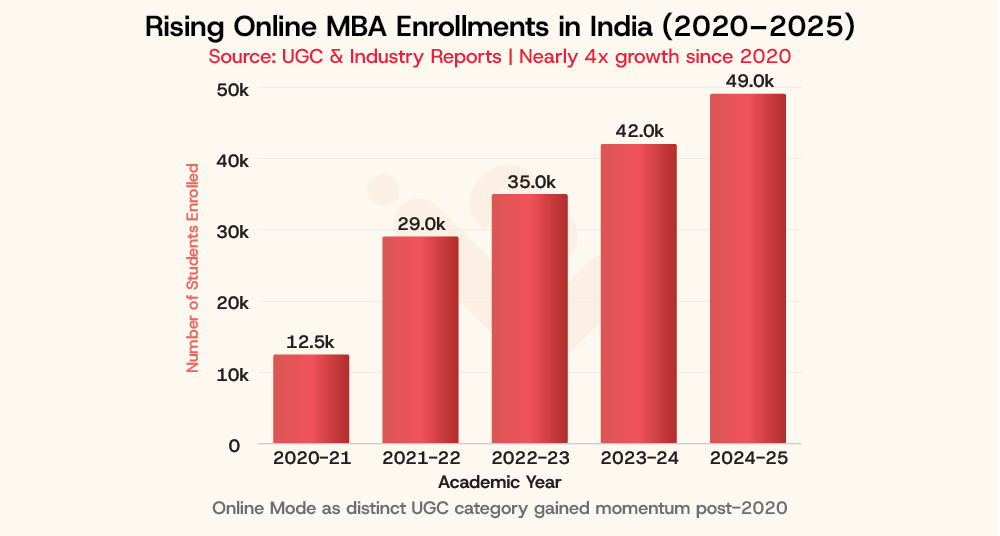
Since COVID, remote and hybrid work is skyrocketing, & it has given more power to this shift to Online degrees. As universities are adapting & offering online degrees, physical campuses are becoming less important than practical exposure, leadership & communication skills. That’s why modern employers expect their managers to be adaptable and capable of leading teams. These are the qualities that online MBAs are designed to develop in both fresh graduates & working professionals.
And in the context of futuristic India, the appeal of online MBA programs lies in their alignment with how careers actually function today. They allow professionals to learn in real time, apply concepts directly at work, and progress academically without pausing their income or momentum. This combination of flexibility, relevance, and accessibility has made the online MBA one of the most compelling CAT-free pathways for modern management aspirants.
Online MBA Universities in India
List of online MBA universities in India offering quality education in a highly flexible mode at an affordable fee range.
| Online MBA University | Approximate Fee Range |
| Amity University Online | ₹2,00,000 |
| NMIMS Online | ₹1,96,000 – ₹2,00,000 |
| Chandigarh University Online | ₹1,65,000 – ₹2,20,000 |
| Symbiosis Centre for Distance Learning (SCDL) | ₹74,000 – ₹3,15,000 |
| Lovely Professional University - LPU Online | ₹1,46,000 |
| Jain University Online | ₹1,75,000 – ₹5,00,000 |
| ICFAI Foundation for Higher Education | ₹2,00,000 |
| UPES Online | ₹1,35,000 |
| MIT School of Distance Education | ₹60,000 – ₹90,000 |
| MAHE Online | ₹2,92,000 |
| Vivekananda Global University Online | ₹1,50,000 – ₹2,40,000 |
| Manipal University Online | ₹1,75,000 |
| DY Patil University Online | ₹1,89,400 |
Why Online MBA Makes Sense. A Feature-by-Feature Breakdown
One of the strongest advantages of an online MBA is that it removes the need for CAT without lowering the bar on learning. Admissions are typically based on academic background, work experience, and personal interviews, making the selection process more holistic. This allows capable candidates to enter management education based on readiness and intent rather than performance on a single exam day.
Flexibility is another defining feature. Online MBA programs can easily fit even if you have a full-time job. Lectures are often recorded and also live, but live classes are conducted outside working hours, which allows learners to study at their own pace. For working professionals, this also means that career growth does not have to be put on hold for getting an MBA. This is a trade-off that regular MBAs never allow.
Cost efficiency makes the case of the online MBA even stronger. How? Let me explain. Most online universities in India offer this course in the range of ₹1.5 lakh to ₹4 lakh INR, which is a fraction of the cost of full-time private MBAs. Plus, when you factor in the absence of relocation expenses, hostel fees, and lost salary, the overall financial risk reduces significantly. For most of the aspirants, this improves the ROI even before the degree is completed.
But here’s the thing, beyond cost of investment & ease, the real value of a degree lies in whether it is relevant to you. The online MBA curriculum is based on market-ready skills such as data-driven decision-making, digital marketing, operations optimisation, and strategic leadership. And since most of the learners are working alongside their studies, they can apply concepts immediately, which reinforces learning using real-world context. This combination of accessibility, affordability, and direct application explains why online MBA programs are becoming a future-ready choice for people seeking a management career path without CAT.
Path #3 - Blended MBA for Working Professionals From IIMs
As management roles are exploding in the market, one skill is becoming non-negotiable: the ability to use the insights in business decision-making. Across strategy, operations, marketing, and consulting, managers work with a lot of data. Their critical thinking skills and business analysis methodology have forced IIMs to come up with some specialised MBA programs for working professionals
IIMs have long been regarded as the gold standard in management education in India. Recognising the growing demand from working professionals, several IIMs now offer blended and online MBA programs that make world-class management education accessible without requiring a career break. These programs are designed for mid-career professionals looking to move into leadership roles while continuing to work.
Unlike traditional full-time programs, blended MBA offerings from IIMs are structured around the schedules of working professionals. Admissions are typically based on academic background, work experience, and overall profile rather than solely on entrance exam scores. The curriculum combines core management principles with contemporary topics such as data-driven decision-making, business analytics, and emerging technologies, preparing professionals for the demands of modern corporate environments.
The IIM brand adds significant credibility to these programs, making them a strong choice for professionals who want recognised credentials alongside practical skill development.
That said, this route is not designed for everyone. The fee structure is higher than most online MBA programs, and the selection process is more selective. A CAT score is generally not required for it, but you will have to pass either the IIM-specific test or an interview session to get admission. It is best suited for mid-career professionals with several years of work experience who have a clear trajectory and can justify the investment. If you’re the one, the IIM MBA offers a premium yet growing niche path. For others, especially early-career working professionals or career switchers, more flexible and cost-efficient online MBA options may provide a better balance between learning, risk, and return.
List of IIMs offering Blended MBA or Online MBA for Working Professionals.
| IIM | Online / Blended MBA (Executive / EPGP) Fees | Regular MBA (2-Year PGP) Fees |
| IIM Ahmedabad | ₹20 Lakhs (Blended MBA in Analytics/AI) | ₹27–32 Lakhs |
| IIM Bangalore | ₹5–8 Lakhs (Executive / online programs) | ₹26–28 Lakhs |
| IIM Calcutta | ₹3–6 Lakhs (Online Executive programs) | ₹27 Lakhs |
| IIM Lucknow | ₹3–5 Lakhs | ₹20–21 Lakhs |
| IIM Indore | ₹14 Lakhs (Executive blended program) | ₹18–21 Lakhs |
| IIM Kozhikode | ₹14.7 Lakhs (Executive PGP) | ₹19–23 Lakhs |
| IIM Shillong | ₹12.35 Lakhs (PGPWE Online) | ₹26.18 Lakhs |
| IIM Ranchi | ₹12.6 Lakhs (Executive MBA) | ₹17–19 Lakhs |
| IIM Udaipur | ₹14.2 Lakhs (Executive MBA) | ₹21.3 Lakhs |
| IIM Jammu | ₹10.91 Lakhs (Executive MBA) | ₹22.8 Lakhs |
| IIM Bodh Gaya | ₹10 Lakhs (Executive MBA) | ₹16–18 Lakhs |
| IIM Sirmaur | ₹8 Lakhs (Executive MBA) | ₹16–20 Lakhs |
Note: The exact fee for your chosen program and institute may vary as it keeps on updating with time for every new session.
Path #4 - Online Executive MBA from Private Universities
While traditional universities, including both private and government, are adapting to change, a new category of MBA programs has emerged with a fundamentally different philosophy. These programs are built around outcomes rather than exams, and execution rather than old prestige. The Online Executive MBA sits firmly in this category, designed for learners who care less about entrance hurdles and more about what the degree actually enables them to do.
This approach to management education is heavily project-driven, with a strong focus on real-world problem solving. Instead of depending on end-term exams as the primary judgment of learning, the program focuses on regular assessment through assignments, case studies, and building a brand. This structure tries to mirror how management skills are practically used in today’s workplace, where performance is judged by business results, not exam marks.
Another defining part of the online EMBA is its accessibility. The admission process does not require CAT, which makes it more inclusive for learners from diverse professional backgrounds. The curriculum is designed to be compatible with working professionals and career switchers, allowing them to develop management qualities without stepping away from employment.
What ultimately differentiates this model is its focus on career outcomes. Universities position this online MBA category as a tool for upward mobility and transition, not just a credential to be added to your resume. They teach you how to build a company of your own rather than selling high placement numbers. For aspirants who value practical skills, relevance, and return on effort over institutional labels, this new-age MBA model offers a smart & strong alternative without the CAT exam.
Here is a list of some popular private universities that offer an online PGDM or an online Executive MBA program at a lower fee range than IIMs.
| University | Program Type | Duration | Approx. Total Fees |
| Amity University Online | Online MBA / Executive-style MBA for working professionals | 2 Years (4 Semesters) | ₹1.99 – ₹2.99 Lakhs depending on specialization |
| NMIMS Global Access School | Online Executive MBA / Executive PGDM | 15–24 Months (varies by program structure) | Around ₹4 Lakhs |
| Manipal Academy of Higher Education (MAHE) | Online MBA with 9+ specializations (Data Science, Analytics, etc.) | 2 Years (4 Semesters) | ₹2.92 Lakhs (₹73,000 per semester) |
| DY Patil Vidyapeeth, Pune | Executive MBA (Online / Distance format) | 1 Year (2 Semesters) | Around ₹1.5 Lakhs |
| Sharda University (School of Business Studies) | Online MBA / Executive-style MBA | 2 Years | Around ₹1.3 – ₹1.5 Lakhs (varies by specialization) |
Cost vs ROI of Traditional MBA vs Online MBA vs Executive Programs
When you’re evaluating an MBA without CAT, if you are focusing only on fees, it will lead you to make an uninformed decision. What is important for a long-term value is the return on investment, which includes not just financial cost but also career interruption, risk exposure, and the time it takes to get significant career benefits. When these factors are placed side by side, the differences between MBA formats become much clearer.
Cost & Risk Comparison Across MBA Formats
| MBA Format | Average Fees (India) | Career Break Required | Income During Study | Financial Risk |
| Private Full-Time MBA | ₹6–25 lakh | Yes, 2 years | No | High |
| Online Executive MBA / Blended MBA | ₹5–15 lakh | No | Yes | Medium |
| Online MBA | ₹1.5–4 lakh | No | Yes | Low |
A traditional full-time MBA from a private university needs a high upfront investment and a complete pause in earnings. Even with good placements, graduates take many years to recover the ROI, especially if education loans are involved (which are there in most cases). The risk becomes even higher due to today’s inconsistent placement outcomes in prestigious institutions. The placement numbers of IIMs are decreasing day by day, but not their selection criteria and fees.
Executive and blended MBA programs, including those from premium institutions, like IIMs, reduce the risk a little bit but introduce a different kind of risk, which is high fees. Justified primarily by brand value or exposure. These programs can work best when participants are already earning well and can leverage that to obtain practical exposure.
On the other hand, online MBAs offer a completely different ROI equation. With such lower fees, no income loss, and the ability to apply learning in real time, the financial negatives are limited. Learners start seeing returns during the program itself through promotions, role expansion, or lateral career moves.
So, from a pure ROI perspective, online MBAs are emerging as the most stable and scalable MBA option without appearing for the CAT.
Who Should Choose Which Path? A Clear Decision Framework
Choosing an MBA without CAT is not only about finding the “best” program but also about choosing the right specialisation & mode of degree.
At what career stage are you?
Are you financially secure & flexible?
And do you really wanna learn management or need a degree from a brand to get a higher placement?
Here’s a structured framework which will help you avoid choices driven by panic, peer pressure, & outdated stereotypes.
MBA Path Selection by Career Profile
| Career Profile | Primary Need | Best-Fit MBA Option | Why It Works |
| Fresh Graduate | Foundation + exposure | Online MBA | Early skill-building without delaying career start |
| 1–3 Years Experience | Role clarity + growth | Online / Outcome-based MBA | Flexibility + immediate application of knowledge. |
| 3–5 Years Experience | Leadership transition | Online MBA / Executive-style programs | Career continuity with skill acceleration |
| 6–10 Years Experience | Strategic repositioning | Executive / Specialised MBA | Brand leverage + niche expertise |
| CAT Repeater | Risk control + ROI | Online MBA | Should avoid time loss and repeated uncertainty |
For early-career professionals, the biggest mistake is delaying work experience in pursuit of an idealised admission outcome. Online MBAs allow learning to compound alongside professional exposure, which often produces stronger long-term results than waiting for a perfect percentile.
For mid-career working professionals, flexibility is non-negotiable. So, programs that can integrate learning with work offer a clear advantage, especially when the goal is promotion or domain transition. Executive and blended MBAs make sense only when the career direction is already fixed, so that the investment can be strategically justified.
The most effective MBA decision is rarely the most prestigious one. It is the one that protects momentum, manages downside risk, and compounds learning over time. In that context, CAT-free pathways, especially online MBAs, are not second choices. They are calculated, future-aligned decisions.
How Recruiters Actually Evaluate MBA Candidates Today
For a long time, MBA aspirants believed that college brand and entrance exam scores were the primary factors driving hiring decisions. That belief is steadily losing relevance. As industries become more dynamic and role requirements more specialised, recruiters have shifted their focus from where a candidate studied to what the candidate can actually do in a business context.
Today, most recruiters use a layered evaluation approach. Academic pedigree may help a résumé get noticed, but it rarely decides the outcome. What carries more weight is the candidate’s ability to solve problems, communicate ideas clearly, work with data, and demonstrate ownership in real-world situations. This is especially true for roles in consulting, product management, operations, marketing, and analytics.
What Recruiters Say vs What They Hire For
| Evaluation Factor | What Candidates Assume Matters | What Recruiters Actually Priorities |
| Entrance Exam Score | Very High | Low to Moderate |
| College Brand | Very High | Moderate |
| Practical Skills | Moderate | Very High |
| Work Experience | Low to Moderate | High |
| Communication & Thinking | Moderate | Very High |
| Project / Case Exposure | Low | High |
Another noticeable shift is the reduced importance of how an MBA was delivered. Whether a degree was earned online or offline matters far less than whether the candidate can apply management concepts effectively. Recruiters increasingly recognise that professionals who study alongside work often bring sharper context, better decision-making maturity, and stronger execution skills to the table.
This change explains why online and outcome-driven MBA programs are gaining acceptance. Candidates from such programs tend to speak in terms of projects, metrics, and impact rather than just theory. From a recruiter’s perspective, this shortens onboarding time and reduces hiring risk.
In today’s job market, an MBA is not judged by the entrance exam that preceded it, but by the competence that follows it. Aspirants who understand this shift stop chasing validation through exams and start investing in skills, experience, and relevance. That mindset, more than any percentile or campus tag, is what consistently improves employability in modern India.
Step-by-Step Guide to Getting an MBA Without CAT
Pursuing an MBA without CAT is not about taking an unplanned detour; it requires the same level of intent and structure as any traditional route. The difference lies in how decisions are made. Instead of optimising for percentile cut-offs, the focus shifts to alignment between career goals, learning format, and long-term return on investment.
The first step is clarity. Aspirants must clearly define why they want an MBA in the first place. Whether the goal is a promotion, a career switch, leadership readiness, or domain specialisation, the objective should guide every subsequent decision. Without this clarity, even a CAT-free MBA can become a misaligned investment.
A Simple Roadmap to MBA Admission Without CAT
| Step | Action | What to Evaluate |
| Step 1 | Write down your career goal |
|
| Step 2 | Choose MBA format | Online, executive, or specialised program |
| Step 3 | Check recognition |
|
| Step 4 | Evaluate ROI |
|
| Step 5 | Shortlist programs | Curriculum relevance, flexibility, outcomes |
| Step 6 | Apply & prepare | Interviews, SOPs, profile-based selection |
Once you have shortlisted a program, you should start investing time in understanding the curriculum and assessment model. Programs that emphasise projects, case studies, and continuous evaluation tend to offer stronger practical exposure. Admission interviews in CAT-free programs often focus on motivation, professional experience, and clarity of intent rather than academic trivia.
At last, aspirants should prepare mentally for a different learning curve. Studying along with work requires discipline and time management, but it also allows for immediate application of concepts. Those who approach an MBA without CAT as a strategic career move, rather than a backup plan, are far more likely to extract meaningful value from the degree.
Is an MBA Without CAT Compromise?
Questions around MBA without CAT are natural, especially when long-standing stereotypes dominate the narrative. Instead of addressing these doubts emotionally, it’s time to answer them directly, with clarity and facts. Below are some of the most common questions aspirants ask before choosing a CAT-free MBA pathway.
Questions That Frequently Come to Your Mind
| Questions | Short Answer |
| Is an MBA without CAT valid in India? | Yes, if offered by a UGC/AICTE-recognised institution. |
| Do employers accept online MBAs? | Increasingly yes, especially with relevant skills and experience. Data shows 67% employers don’t have any issues with an Online degree. |
| Is CAT mandatory for all IIM-related programs? | No, executive and professional MBA programs don’t require CAT. |
| Is an online MBA inferior to a regular MBA? | Not in outcomes, if curriculum and application are strong. |
| Can I switch careers with an MBA without CAT? | Yes, but you need to work on your skills and project-based programs. |
| Will my salary be lower after an online MBA? | Not necessarily, outcomes depend on role, skills, and experience. |
One of the biggest concerns is validity. An MBA without CAT is fully valid if the program is recognised by the appropriate regulatory bodies, ie, UGC-DEB. Recently, UGC, in their notification, has made it very clear that an Online degree course and a regular course are equivalent to each other. Mode of admission does not determine the degree’s validity.
Another frequent worry is employer perception. In practice, recruiters rarely ask how a candidate entered an MBA program. What matters is how well the candidate understands business problems, communicates solutions, and demonstrates impact. For working professionals, the combination of experience and an applied MBA often strengthens, rather than weakens, employability.
Career switching is also possible without CAT, provided expectations are realistic. Programs that emphasise projects, case studies, and industry exposure tend to support transitions more effectively than theory-heavy formats. Ultimately, an MBA without CAT works best when chosen intentionally, as a strategic career move, not a last resort.
Choosing the Path That Compounds
At this point, one thing should be very clear – In today’s date, there is no “right” way to build a management career in India anymore. CAT does remain a valid path for some students, but it is no longer the only way to grow. What matters the most is choosing an MBA that aligns with your current reality, protects your sanity, and compounds your effort with time.
If you are serious about moving into management, leadership, or higher roles, your next step shouldn't be chasing another entrance exam cycle out of habit. Evaluate your options with clarity. Understanding of cost, flexibility, learning outcomes, and long-term return will help you make the right decision.
The future is for people who can make decisions on facts and adapt quickly. Doesn’t matter if you are a student planning your first big career move or a working professional ready to move up to a managerial position, the smart investment will be the one that starts paying back while you are still learning. So, choose a path that keeps you moving forward, every single day.
Final Thought. One Exam Should Not Decide Your Lifetime.
For decades, CAT has been treated as a defining moment in someone’s career. Clear it, and the future looks secure; miss it, and the career feels like a failure. But careers do not depend on a single moment anymore. It takes time because a career is shaped by decisions, the ability to adapt, and the hunger to learn continuously. In today's reality, allowing one exam to carry the whole weight of your career makes no sense at all.
India’s working landscape is changing faster than ever. Roles are evolving, industries are converging, and managers are expected to think across domains rather than operate within rigid dimensions. In such an environment, relevance matters more than rank, and execution matters more than the institute’s reputation. Education that can align with your reality will have greater long-term value than blindly going after CAT.
An MBA without CAT is not a compromise, but a reflection of how learning and careers function in today’s market. Whether you’re going for an online MBA, an executive MBA, or outcome-driven MBAs, these pathways democratise ambition. They recognise that growth can happen along with work, responsibility, and real-world problems, if you’re dedicated enough.
The most successful professionals are rarely those who followed the most conventional path. They are the ones who made informed, timely decisions and adapted when circumstances demanded it. CAT can be one such path, but it should never be the only one. In a futuristic India, progress belongs to those who choose direction over validation and build careers that compound, not pause, over time.