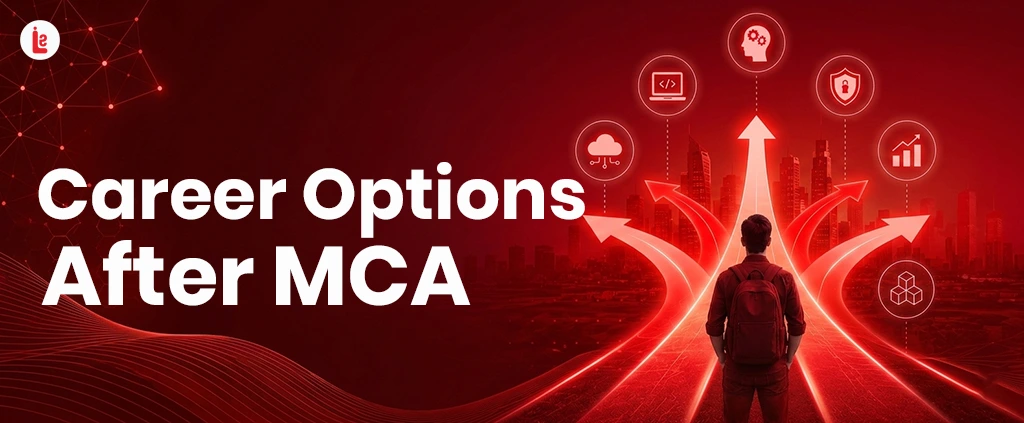
Your future after the MCA course in today’s digital world will be swayed by the decisions you take today. Whether you are choosing to further strengthen your academics or immediately want to start working in corporates, career options after MCA in 2026 promise opportunities in both ways.
A Master of Computer Applications program has a strong demand amongst both working professionals and fresh graduates, because of the roles it prepares you for, offering a promising long-term career. You can start working as a data scientist, cloud architect, cybersecurity analyst, or software developer, or choose to further level up your prerequisite skills via academics.
What is the MCA Demand in 2026 and its Future Scope?
A Master of Computer Applications is a two-year post-graduation course, offering an industry-oriented professional degree, with comprehensive skill development in the computer applications field. These include advanced computer science applications, software development, and modern technologies like AI, Data Science, and Cybersecurity.
Since this is a course whose future is dependent upon key AI developments, adjustments due to artificial intelligence growth in the computer applications area may force more frequent updates in its curriculum than traditional degrees.
Thus, your career goals after this course depend on the specialisations you have selected and the post-MCA career path you want to go for. While achieving their set goals in this competitive world, students need to manage both academic and professional lives, and an online MCA course option will take a lot of complexities out of the equation.
You get an equally valuable degree, with further benefits such as direct admission (no entrance exam), lower tuition fees, and easy-to-access virtual learning.
Top Career Options After MCA: High-Paying Specialisations and Job Roles
We are moving ahead into an AI-led economy, and job opportunities for Master of Computer Applications graduates are getting shaped around it. After the completion of the Master's of Computer Applications degree, you can start working as a software developer, Cloud Architect, AI/ML engineer, Data Scientist, etc.
However, opportunities are not limited to the private sector, as PSUs and premier government agencies offer vacancies in some of the most respected and influential roles.
These two sectors offer some of the most trending and respected jobs.
Trending Private Sector Jobs after MCA in 2026
If you like challenging and high-growth-oriented opportunities in your field of interest as a professional, then the private sector job roles after MCA in 2026 are both exciting and unpredictable at the same time.
| Pvt Job Profile | MCA Specialisations | Salary |
| AI/ML Engineer | Artificial Intelligence & Machine Learning | Rs 10 LPA |
| Data Scientist | Data Science / Data Analytics | Rs 10 LPA |
| Full Stack Developer | Software Development / Full Stack Web Development | Rs 7 LPA |
| Cybersecurity Specialist | Cybersecurity / Information Security | Rs 5.88 LPA |
| DevOps Engineer | Cloud Computing / DevOps Engineering | Rs 9.95 LPA |
| Mobile Application Developer | Mobile Application Development / Software Systems | Rs 7 LPA |
| Data Analyst | Data Analytics / Business Intelligence | Rs 5.77 LPA |
| Database Administrator (DBA) | Database Management Systems / General MCA | Rs 6.35 LPA |
| Cloud Software Engineer | Cloud Computing / Infrastructure Systems | Rs 8.24 LPA |
| Software Quality Assurance | Software Engineering / Software Testing | Rs 5 LPA |
Source: Payscale
Major recruiters: Google, Amazon, Microsoft, TCS, Infosys, Accenture, Flipkart, and fintech startups.
Top Government and PSU Sector Job Opportunities after MCA
The following are the popular government job positions amongst MCA graduates, seeking more stable and steady growth careers, with lofty perks over base salaries and a massive influence in our society.
| Gov Sectors | Job Profiles | Exams | Salary |
| PSU Jobs (NTPC, ONGC, IOCL, PGCIL, |
| GATE | Rs 40,000 - 180,000 Per Month |
| Space and Defence Sector Jobs (DRDO, ISRO, BARC, MEITY) |
| Independent Selection Tests for
| Rs 56,100 - 1,05,000 |
| Banking and Financial Sector Jobs (SBI, ISB, RBI) |
| IBPS SO, SBI SO, RBI Grade B Selection | Rs 70,000 - Rs 85,000 per month |
| Civil Services Jobs (SSC CGL, Railway Recruitment Board) |
| NTA, SSC CGL, RRB JE/SSE | Rs 75,000 - Rs 95,000 per month |
Source: RBI
Top Hiring Government organisations: ONGC, NTPC, BHEL, IOCL, DRDO, ISRO, NIC, and various banks
Top Academic Career Options after completing MCA
Your career options after completing this degree are not very vast, but the available options are amongst some of the most prolific ones. Let’s take a look at their basic details.
Full-time Courses after MCA degree
After completing the Master of Computer Applications, you can choose to pursue the full-time course from the following. These courses open doors for higher-end salaried roles in relevant industries, based on the specialisation you choose.
Let’s have a look at each of them and understand why they still hold relevance for computer applications graduates.
M.Tech in Computer Science / IT
Master of Technology in Computer Science enables you to gain expertise in deeper engineering domains such as system architecture, underlying infrastructure, algorithms, and hardware-software interface.
This way, you get to prepare yourself for high-end tech roles or go for a PhD if interested in profound research, innovation, or teaching roles at universities.
Having an MCA+MTech degree can break through to senior leadership positions, where you can aim for roles such as Chief Technology Officer (CTO) or Principal Systems Engineer.
- Duration: 2 Years
- Entrance Exams: Varies based on Institution (GATE, PGEE, PGCET, BITS HD, CUET PG, etc.)
- Specialisations: AI, Data Science, Cybersecurity, Cloud Computing
- Job Roles: Senior Software Engineer, Research Scientist, Technical Architect, University Lecturer
- Average Salary: Rs 10 LPA
Source: Payscale
PhD in Computer Applications / Computer Science
To further strengthen your theory and get into a deeper level of understanding of the computer applications ecosystem, so that you can design and develop breakthroughs into the computer applications world, requires a PhD in Computer Science.
As an MCA graduate, you get to work in high-risk, high-reward sectors such as Quantum Computing architectures, foundational mathematical modelling, secure cryptographic protocols for next-generation AI (such as LLMs), and protection against cybersecurity threats.
- Duration: 3-5 years
- Entrance Exams: Varies based on Institution (UGC NET, CSIR NET, GATE, PGEE, PGCET, BITS HD, CUCET/CUET PG, etc.)
- Specialisations: Artificial Intelligence, Machine Learning, Data Analytics, Network Security
- Job Roles: Professor, Research Scientist in DRDO/ISRO, Chief Technology Officer, Independent Researcher
MBA in IT / Systems / Business Analytics
If you want to go for management roles, such as how to handle computer application talents and lead them, then an MBA degree after MCA will help you learn why a certain system is needed, and with the help of your team, use data to deliver competitive corporate goals in an organisation.
This way, you can avoid the technical coding career limits and help yourself rise to growth-oriented roles. You need to appear for highly competitive and challenging entrance examinations to secure your seat in a reputed B-School, as the competition level is amongst the highest in the country.
- Duration: 2 years
- Entrance Exams: CAT, MAT, XAT, GMAT, etc.
- Specialisations: IT Management, Digital Leadership, Business Analytics, FinTech.
- Job Roles: IT Manager, Project Manager, Business Analyst, Chief Information Officer
- Average Salary: Rs 12 LPA
Source: Ambitionbox
Why choose an online MBA degree after completing your MCA course?
You can choose to opt for an MBA program from UGC-DEB recognised online universities and earn an equally valuable degree. With that choice, you do not need to go through national-level competitive entrance exams, enabling direct admission for your powerful career move.
Let’s have a look at the important benefits of a fully online MBA degree:
- Direct Admission: No need to appear for GATE, UGC NET, or any other entrance exam
- UGC-Approved Degree: Online MBA is equivalent to the on-campus counterpart program
- Lower Fee Amount: Significant savings on your tuition fees (up to 40-80%)
- Effective Virtual learning: You do not need to step out, pick up your PC, and start your Online MBA course.
- Avoid unnecessary Hustle: Save further on commute and accommodation, and eliminate daily up-down traffic issues and away-from-home problems.
Short -Term Skill Development Courses for MCA students
After earning a PG in computer applications degree, if you want to specialise in a niche industry, and that too within a short span and as per your convenience, then the following certifications offer the same.
Data Science and AI Certification
Certification in this segment enables you to pursue more specialised skill development for future-proof career roles. Data Science and AI certification after MCA helps you learn how to apply your computer application skills to ML and AI.
This requires studying data science, statistical modelling, natural language processing, and predictive analytics. After completion, you can start working as a data scientist or AI engineer and, with experience, become an industry-level expert, which paves the way for more senior positions.
- Duration: 3-6 months
- Specialisations: Machine Learning, Deep Learning, Generative AI
- Job Roles: Data Scientist, AI Engineer, ML Specialist, Business Intelligence Analyst
- Average Salary: Rs 10-12 LPA
Source: Payscale
Cloud Computing Certification (AWS/Azure/GCP)
Once you have your Master's in Computer Applications degree, you can apply for high-end roles in the tech industry. By earning a certification in cloud computing from its top providers, such as AWS, Azure, and GCP, you open your professional door towards architectural roles.
This certification helps you professionally learn how to implement computer application to large, scale live and secure environments (server or cloud) globally on modern infrastructures. You can apply for roles such as a cloud architect or a cloud engineer, which are in high demand in the market.
- Duration: 2-4 months
- Specialisations: Cloud Architecture, DevOps, Cloud Security
- Job Roles: Cloud Architect, Cloud Engineer, DevOps Engineer, Solutions Architect
- Average Salary: Rs 12-14 LPA
Source: Payscale
Cybersecurity Certification (CEH, CompTIA Security+)
These certifications help you achieve excellence in defending the digital systems from fraud and illegal access, which a software engineer develops. This includes finding vulnerabilities in the system and fixing its security breaches.
Considering the report by MarketsandMarkets, this space is estimated to grow over 9% CAGR per year until 2030, taking the total cybersecurity market value up to 351 billion US dollars.
- Duration: 3-6 months
- Specialisations: Ethical Hacking, Network Security, Cyber Forensics
- Job Roles: Cybersecurity Analyst, Security Engineer, Penetration Tester, Information Security Officer
- Average Salary: Rs 8-10 LPA
Source: Payscale
Full Stack Development / DevOps Course
This course, after an MCA degree, helps in becoming a developer who understands how to use the modern frameworks such as the MERN stack: MongoDB, Express.js, React, and Node.js. DevOps provides you with the knowledge of automation deployment in the system using industry-standard tools like Docker, Kubernetes, Jenkins, and Git.
- Duration: 3-6 months
- Specialisations: MERN Stack, MEAN Stack, CI/CD Pipelines
- Job Roles: Full Stack Developer, Backend Developer, DevOps Engineer, Software Engineer
- Average Salary: Rs 7-9 LPA
Source: Payscale
How 100% online Short -Term courses help working professionals achieve more?
Online courses with 3-12 months duration after MCA in the new and emerging tech-oriented industries, such as data analytics, cyber security, Artificial Intelligence, machine learning, etc, offer more advanced skills. These courses are generally available in the category of online PG Diploma and Certifications.
Let’s see how you can benefit from the following short-term courses after:
- Direct Admission: You just need to apply online using your personal details and requisite documents, and you are ready to start learning modern-tech industry skills.
- Lower Fee Amount (30-60%): With these short-duration courses, which focus on developing key skills precisely, they offer a lower fee structure compared to on-campus counterparts.
- Online LMS: Learning Management Systems of online universities offer seamless skill development over personal computers, allowing a comfortable and flexible learning experience.
- Zero Commute: You learn from the comfort of your home, meaning no daily up-down traffic hassles and accommodation challenges.
- Flexible for Working Professionals: You can work as a full-time professional and still learn new skills from the comfort of your screen, without feeling the need to take any career pause.
Conclusion
Career options after MCA provide you with the opportunity to aim for high-end roles by pursuing further academic excellence, and at the same time, you can start working as a professional in the corporate sector.
Your first job is to decide which way to go and then find the most suitable opportunity. You can get jobs such as software developer, AI/ML engineer, cloud engineer, or choose to do an M.Tech or MBA degree to target high-end tech execution and leadership roles.
In the modern world, online universities provide equally credible degrees and offer a fully effective learning experience to their students. This is why many working professionals choose to work and study simultaneously, balancing both professional responsibilities and skill development.