In today's ever-changing world, finance and business play a very important role in almost all industries. A Bachelor of Commerce (BCom) is not just a degree; it's a popular course that helps students to understand how businesses work, how money can be managed, and how to make financial decisions.
It covers subjects related to finance, marketing, accounting, and economics. Choosing the right specialisation is also very important because it will shape your future, career path and job satisfaction which you want to do.
So today in this log, we will talk about the BCom subjects, syllabus, scope, top universities, specialisation, which will guide you for your future.
What is BCom?
A B.Com is a Bachelor of Commerce program with 3 years, and it is divided into 6 semesters. This program can be done in both regular and online modes. This program provides many specialisations with different subjects. Students gain a higher understanding of business with in-depth knowledge of finance and accounting.
BCom Subjects and Syllabus
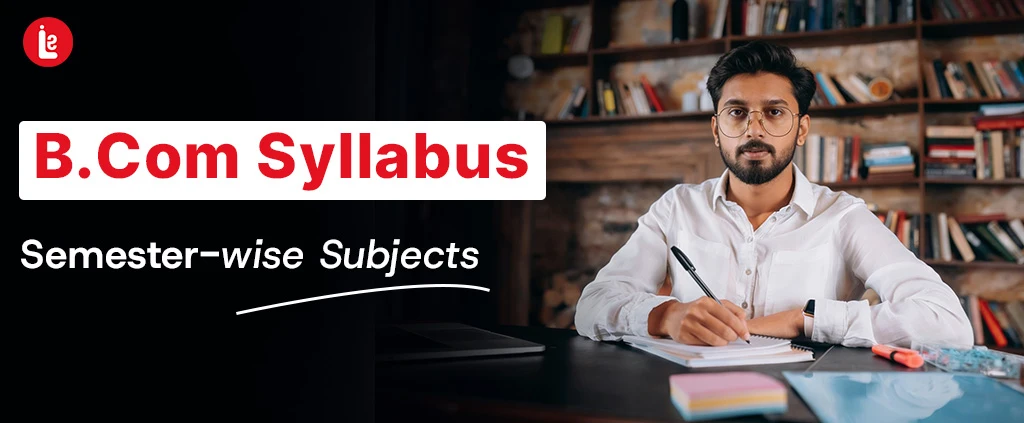
The BCom syllabus focuses on foundational concepts in the field of commerce. It covers all the core subjects, such as business organisation, financial accounting, management, business law/mathematics, and business economics. It is designed to build a strong understanding of economic theory, regulatory framework, and accounting principles.
1st Year Curriculum
Year 1 is where you lay down your fundamentals. Here you will learn the ABCs of commerce; there is no stress, but you are exposed to the functioning of a business and its accounting practices.
As you can see from the table below, the BCom 1st semester subjects and 2nd year subjects are listed.
| Semesters | Subjects |
| 1st Semester |
|
| 2nd Semester |
|
Common subjects taught in this:
- Financial Accounting – Recording business transactions, balance sheet preparation, and understanding P&L.
- Business Organisation and Management – Understanding what business is? Company forms, basics of management, planning, and coordination of human efforts.
- Business Economics (Micro and Macro) – Micro-level business economics, including demand, supply, and pricing. Macroeconomics includes inflation, GDP growth, and economic policies.
- Business Law / Business Communication – Basic concepts of business law agreements, contracts, etc., and business communication, like email writing and report writing.
- Business Mathematics / Statistics – Elementary mathematics, including percentages and averages used in business. Graph interpretation.
- Environmental Studies or Computer – These are compulsory subjects that generally involve awareness.
In simpler words, Year 1 lays down the foundation of understanding accounting principles and business. Theory-laden but with elementary practical problems included.
2nd Year Curriculum
Things become a bit serious here because you will learn all about companies, taxes, and other aspects of commerce.
As you can see from the table below, the BCom 3rd-semester subjects and 4th-year subjects are listed.
| Semesters | Subjects |
| 3rd Semester |
|
| 4th Semester |
|
Common subjects taught in this:
- Corporate Accounting - Accounting principles applied to larger corporations, stockholder accounting, debenture accounting, and final accounts of companies.
- Cost Accounting - Principles for calculating the true cost of goods or services provided are essential for efficient business expense management.
- Company Law - Laws on registration, administration, role of directors, meetings, etc.
- Income Tax Law and Practice - Principles of calculation and submission of income tax payable by individuals and organizations.
- Business Statistics/Banking and Insurance - More statistics and banking or insurance.
- Human Resource Management/Marketing - Managing manpower or marketing products and services.
- E-Commerce/Computer Applications - Using computers in business.
In simple words: Year 2 gives you the tools of commerce, such as laws, costing, taxation, and people and money management. It makes the theories relevant to actual business problems. Students often consider this the professional phase of the course.
3rd Year Curriculum
This will be your last year in BCom. This year, you will learn advanced concepts along with elective subjects according to your interest in finance, taxation, marketing, or banking.
As you can see from the table below, 5th-semester subjects and bcom 6th-semester subjects are listed.
| Semesters | Subjects |
| 5th Semester |
|
| 6th Semester |
|
Common subjects taught in this:
- Auditing: It includes auditing the accounts of organizations to verify whether they are proper or not.
- Financial Management: It covers the processes of fundraising, investments, budgeting, and financial decision-making by companies.
- Management Accounting: Making decisions using accounting information.
- Indirect Taxes or Corporate Tax Planning: Concepts of GST and Corporate Tax Planning.
- Entrepreneurship/International Business: Basic concepts related to entrepreneurship and international business.
- Electives (choose): Advanced accounting, banking, investment management, consumer behavior, etc.
- Possibly: Project Work, Internship, or viva
In simple words, this year's focus will be on professional skills and decision-making. You will learn advanced concepts related to auditing, financial management, tax planning, and specialization in your chosen areas. In addition, this will help you prepare for employment or advanced courses such as M.Com, CA, CS, CMA, MBA, and other competitive examinations.
BCom Specializations Syllabus
Choosing the right course is very important for your career, as it truly matches your interests. By pursuing the right course, you can get excellent job options in various industries. This degree provides a great career path for you to enhance your skills and knowledge.
The biggest advantage of earning a B.Com degree is that it can lead to well-paying jobs, as B.Com subjects offer the opportunity to specialize in various fields. B.Com specialization also offers opportunities for careers in the government sector. Candidates pursuing a B.Com specialization gain the skills necessary to grow their businesses and become entrepreneurs.
Types of the Best BCom courses in India
- BCom General: The duration of the BCom general is 3 years. This course covers a wide array of disciplines ranging from economics, tax, auditing, law, and accounting. It is ideal for students seeking to increase their knowledge in trades and, at the same time, remain flexible regarding employment prospects.
- BCom Honours: The duration for the BCom honours is 3-4 years. Through the BCom honours course, students get to specialize in a certain area such as accounting, financial management, or economics, among other courses within the major. Students seeking specialized courses or intending to enroll in further education choose this course due to its comprehensive nature.
- BCom Elective (online): B.Com electives are specialized, optional subjects chosen in the final year that align with specific career goals, such as finance, marketing, human resources, or data analytics. These subjects enable students to gain in-depth knowledge in areas such as taxation, digital marketing, or international business, complementing the core commerce subjects.
Top B.Com Specialisations
The bcom top specialisation can be done in both online and regular mode from a UGC approved university. You can choose the BCom specialisation according to the job role you want to pursue in the future or while working in an online mode. As you can see, the table below shows the top BCom specialisations with the mode of study and their job roles.
| Top BCom Specialization | Mode | Job Roles |
| General International Finance and Accounting | Both (Regular or Online) |
|
| Corporate Accounting | Both (Regular or Online) |
|
| Banking & FinTech | Both (Regular or Online) |
|
| Accounting with AI | Both (Regular or Online) |
|
| Business Accounting & Taxation | Both (Regular or Online) |
|
| Business Analytics | Both (Regular or Online) |
|
| E-Commerce | Both (Regular or Online) |
|
| Digital Marketing with AI | Both (Regular or Online) |
|
| Finance Management | Both (Regular or Online) |
|
| Economics | Mostly Regular (Online options available) |
|
| Financial Analytics | Both (Regular or Online) |
|
| Accounting and Finance | Both (Regular or Online) |
|
BCom Accounting and Finance Subjects
| Semester 1 | Semester 2 |
|
|
| Semester 3 | Semester 4 |
|
|
| Semester 5 | Semester 6 |
|
|
BCom Computer Application Subjects
| Semester 1 | Semester 2 |
|
|
| Semester 3 | Semester 4 |
|
|
| Semester 5 | Semester 6 |
|
|
BCom Taxation Subjects
| Semester 1 | Semester 2 |
|
|
| Semester 3 | Semester 4 |
|
|
| Semester 5 | Semester 6 |
|
|
BCom Cooperation Subjects
| Semester 1 | Semester 2 |
|
|
| Semester 3 | Semester 4 |
|
|
| Semester 5 | Semester 6 |
|
|
Top BCom Colleges with fees
You can pursue the B.Com from both private and government colleges in both online and regular modes. These universities provide placement assistance to students along with campus amenities. As you can see, the table below shows the list of top colleges with their type and the approximate fee ranges.
| College Name | Type | Approx Total INR Course Fees |
| SRCC | Government | ₹30,000 - ₹97,000 |
| Hindu College | Government | ₹18,000 - ₹86,000 |
| LSR College | Government | ₹20,000 - ₹82,000 |
| Hansraj College | Government | ₹540 - ₹91,000 |
| Loyola College | Private | ₹48,000 - ₹95,000 |
| St. Xavier's College | Private | ₹23,360 - ₹25,000 |
| Christ University | Private | ₹2.45 - 11 Lakh |
| NM College | Public-Pvt | ₹43,000 - ₹2.25 Lakh |
| Symbiosis (SCCA) | Private | ₹92,000 - ₹4.28 Lakh |
| Mithibai College | Private | ₹30,000 - ₹1.77 Lakh |
| Amity University | Private | ₹5.5 - 13.2 Lakh |
| SJCC | Private | ₹2.57 - 7 Lakh |
| Jain University | Private | ₹5.25 - 9 Lakh |
| MCC | Private | ₹83,700 |
| Galgotias University | Private | ₹2.85 - 3.84 Lakh |
BCom Entrance Exams
Some of the best BCom entrance exams for 2026 are CUET-UG, NPAT, SET, IPMAT, and University-specific Entrance Test. These online exams test mainly in English, Quantitative Aptitude, General Awareness, and Logical Reasoning, and target top universities and highly-rated colleges.
As you can see, the table below shows the list of entrance exams, their conducting body, and the estimated schedule month.
| Entrance Exam Name | Conducting Body | Estimated Schedule |
| CUET-UG | NTA | May - June 2026 |
| IPU CET | GGSIPU | May 2026 |
| NPAT | NMIMS | Feb - May 2026 |
| SET | Symbiosis | May 2026 |
| AIMA UGAT | AIMA | June 2026 |
| JMI Entrance | JMI | May-June 2026 |
Why choose an online BCom?
You should choose the online BCom because of its flexibility, affordability, and ability to balance work life with study. It allows you to learn according to your own time. It offers the same value as a traditional degree from a UGC approved university. It enables working professionals and students to gain skills in management, accounting, and finance without quitting their jobs or facing any geographical commuting limitations.
Below are the benefits and reasons to choose an online BCom:
- Flexibility & Convenience: One of the biggest benefits of an online BCom program is the flexibility it offers. You can study from any place and at any time as per your preference. This is especially beneficial if you are a working professional or if you have other commitments that you need to balance with your studies.
- Affordability: Online BCom programs are usually cheaper than regular, on-campus courses. Along with lower tuition, there is no need to spend money on transportation or living expenses.
- Work While Studying: One can carry on with their professional career while enrolling for academic qualifications, which would help in the direct application of learned concepts to work.
- Quality Education & Study Material: Besides learning from renowned professors, students participate in live sessions, access digital libraries and handouts, watch recorded lectures, and much more.
- Accessibility to Top Universities: With no geographical constraints, students are free to pick favorable universities offering the commerce degree, even if they are situated in different parts of the world.
- Ideal for Specialized Career Paths: Candidates who are targeting professional certifications like Chartered Accountancy (CA) or CS will find online BCom quite convenient, as it offers the necessary time flexibility to handle both.
- Industry-Relevant Curriculum: Updating of courses happens regularly so that it reflects today's industry needs, thereby helping students acquire skills like digital marketing, analytics, and the use of contemporary accounting software.
Top 8 BCom online Colleges with fees
The table below shows the top online BCom colleges with the Full fees at an affordable cost.
| Top Online College Name | Fees (INR Total) |
| MAHE Online | ₹2,94,000 |
| Sikkim Manipal University Online | ₹75,000 |
| Alliance University Online | ₹76,000 |
| Kurukshetra University Online | ₹72,661 |
| Jain University Online | ₹1,20,000 |
| Amity University Online | ₹1,15,000 |
| Manipal University Online | ₹99,000 |
| NMIMS Online | ₹1,08,000 |
Scope of BCom in India
The scope of the Bachelor of Commerce is very wide and growing day by day. There is a need for people who can understand finance, taxation, business management, and accounting as businesses and the economy continue expanding.
The degree provides you with in-depth knowledge of core subjects, helps you find a wide range of career options in marketing, insurance, accounting, finance, and banking, or even start your own business.
You can also pursue higher studies such as MCom, MBA, CA, CS, or CMA. These higher positions will lead you to better job positions and higher salaries. With the growing number of startups and digital businesses in India, bcom graduates can also find better opportunities in digital marketing, financial technology, and E-commerce.
The key differences between online and regular BCom
| Feature | Online B.Com | Regular B.Com |
| Mode of Delivery | 100% Digital (LMS, recorded/live classes) | Physical classroom, on-campus |
| Flexibility | High; self-paced, study anytime/anywhere | Low; fixed schedule, strict attendance |
| Cost | Generally lower (no commuting/hostel fees) | Generally higher (campus fees, commute, living) |
| Interaction | Virtual discussion forums, live chats, and emails | In-person face-to-face with peers and faculty |
| Networking | Global digital network | Local/regional peer networking |
| Exam Mode | Online, often proctored | Pen-and-paper, on-campus |
| Curriculum | Often updated, industry-relevant | Follows a structured university academic cycle |
| Ideal For | Working professionals, CA aspirants, flexible learners | Fresh 12th pass students, those seeking campus life |
| Recognition | UGC-DEB-approved degrees are equivalent to regular degrees | Universally recognized, established |
Conclusion
The Bachelor of Commerce (BCom) curriculum provides a strong basic knowledge in finance, business, law, economics, accounting, and management. It is designed to bridge the gap between the theoretical and practical knowledge of industry applications. The six-semester structure ensures that you will develop both theoretical and practical skills, such as taxation & cost accounting, and practical skills such as critical thinking & communication.